

A pet treat production project for a client in Africa is now fully operational, manufacturing dog chews, meat strips, and jerky slices. The production capacity is 100-150 kg/h for dog chews and 200-300 kg/h for meat strips and jerky slices. The project provides a practical reference for companies planning to enter the African pet treat market or expand into a broader range of pet treat products.
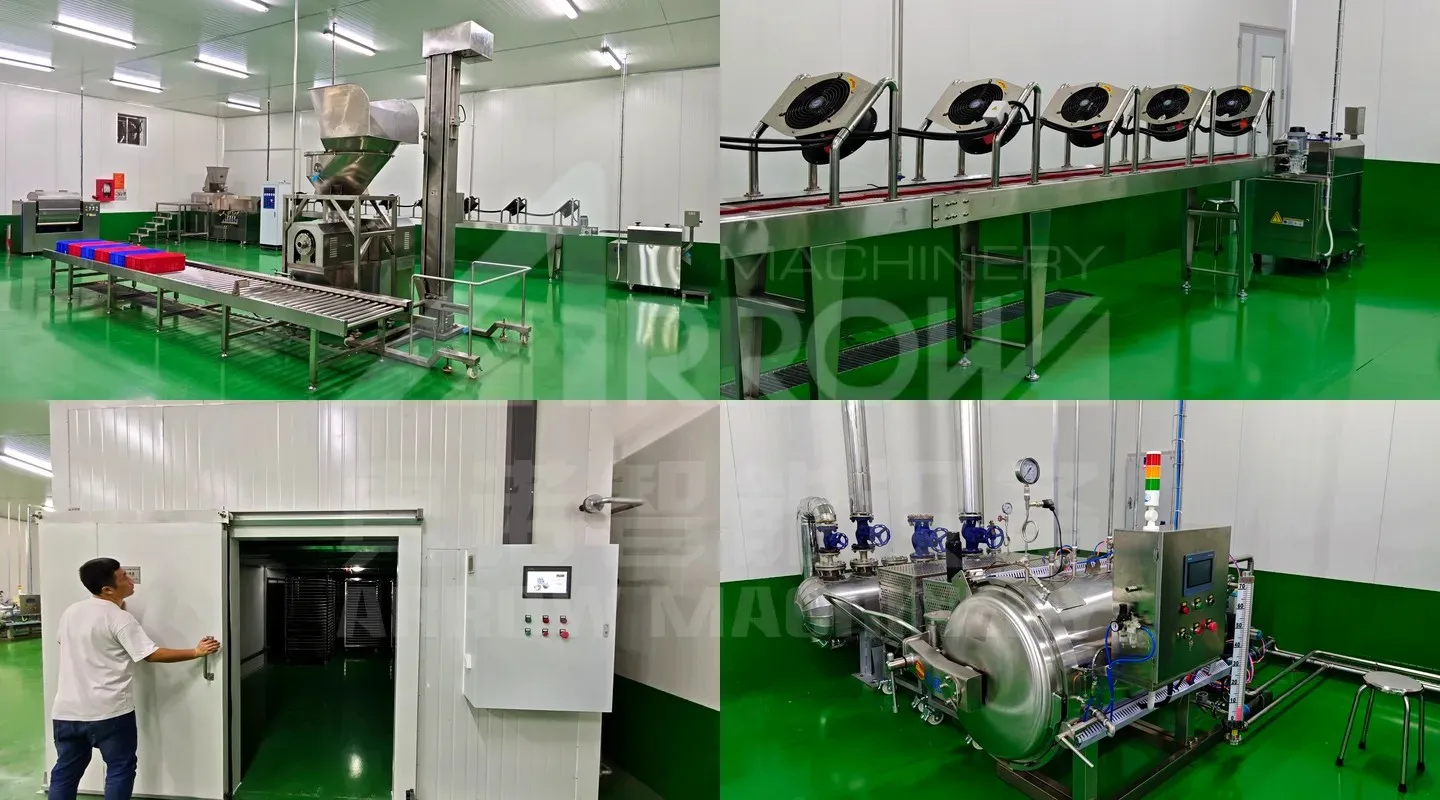
A key feature of this project is its multi-product scope. Rather than focusing on a single type of treat, the client has integrated production lines for dog chews, meat strips, and jerky slices. With the facility now in operation, production can be scheduled for different products according to specific orders and operating plans.
The project is organized around distinct output requirements for each product category. Dog chew production is planned at 100-150 kg/h, while the meat strip and jerky slice lines are planned at 200-300 kg/h. Separating these requirements at the planning stage helps align equipment configuration with the products to be manufactured and the expected production rhythm.
In pet treat manufacturing, products may differ in shape, raw material condition, forming method, and downstream processing requirements. A project that covers several product types therefore needs to balance multiple considerations:
(1) The product mix should reflect the intended market demand and order structure.
(2) Each product category should have a clearly defined capacity range and production target.
(3) Equipment units should be connected into a workable process flow rather than selected as isolated machines.
(4) The production plan should be coordinated with facility space, utilities, drying or post-processing arrangements, and packaging requirements.
Planning around only one product or one piece of equipment can create difficulties when production changes to another treat format. These difficulties may affect material preparation, forming, drying, post-processing, packaging, and the movement of operators and materials through the facility.
For this project, the planning process began by defining the capacity range for each product category: 100-150 kg/h for dog chews and 200-300 kg/h for meat strips and jerky slices. The workflow from raw material preparation and forming through drying or post-processing and packaging was then integrated around product specifications, formulations, raw material characteristics, single-shift output targets, changeover frequency, and packaging requirements.
For companies exploring pet treat production, this product-by-product planning method offers a practical starting point. Requirements can be clarified for each product before the equipment list and overall process arrangement are finalized.
For clients producing both dog chews and meat strips or slices, equipment selection cannot be based on production capacity alone. The solution also needs to consider product specification compatibility, the continuity of the operating flow, and the ease of making future adjustments.
For this African project, Shandong Arrow developed a solution around the client's product portfolio and target output. The planning approach used operational project experience as a reference while keeping the configuration connected to the client's actual products and production goals.
In practical terms, the process follows three steps. First, the specific requirements for dog chews, meat strips, and jerky slices are identified. Second, target capacities, including 100-150 kg/h for dog chews and 200-300 kg/h for meat strips and jerky slices, are incorporated into the production plan. Third, factors such as facility layout, utility requirements, product changeover, and packaging are considered together to create a cohesive production flow.
This approach helps project teams discuss the complete production system at an early stage. It also provides a clearer basis for reviewing equipment connectivity, floor operations, and future product scheduling before the line is installed.
Companies planning a pet treat project in Africa or other markets can prepare several types of information before discussing equipment configuration and plant layout:
(1) Product samples or product specifications.
(2) Raw materials and formulations.
(3) Target production capacity for each product.
(4) Shift schedules and expected production arrangements.
(5) Available facility space and site conditions.
(6) Packaging requirements and downstream processing needs.
These details help establish the relationship between the products, the target output, the process sequence, and the required equipment. They also support a more focused discussion of line layout, production flow, and product changeover arrangements.
To discuss a pet treat production project, submit your requirements through the Contact Us page, reach out on WhatsApp at +86-13793167756 / +86-19953182807, or email info@arrowextrusion.com.
Q1: How can we avoid equipment integration problems or difficult product changeovers when producing several types of pet treats?
A: Define the specifications, raw materials, formulations, target capacity, and changeover frequency for each product individually, including dog chews, meat strips, and jerky slices. These requirements can then be reviewed together with facility space and packaging conditions to map the production flow and identify potential issues with equipment connectivity or operating layout during the planning stage.
Q2: Can a production line for dog chews, meat strips, and jerky slices meet the target output?
A: The planned capacity for this project is 100-150 kg/h for dog chews and 200-300 kg/h for meat strips and jerky slices. A system with these capacity ranges is already in operation at a client's site in Africa. Actual output should be determined according to product dimensions, raw materials, and process conditions. It cannot be assessed solely from the specifications of an individual machine.
Q3: Can preliminary planning start if the client does not yet have a complete recipe or facility specification?
A: Preliminary discussions can begin with the information available. To develop a precise equipment configuration and plant layout, the project will eventually require key details such as product samples or specifications, raw materials and recipes, target capacity, shift schedules, facility conditions, and packaging requirements.
Technical Support: Yandex






 +86-531-83146566
 info@arrowextrusion.com