

With the continued expansion of the global pet food market, premium wet pet food has become one of the fastest-growing categories. Consumers have increasingly higher demands for products, including higher meat content, better palatability, functional nutrition, and quality comparable to human food. For pet food manufacturers, investing in efficient wet pet food production lines has become crucial for improving product quality, expanding production capacity, and maintaining competitiveness.
Whether you are planning to build a new pet food factory, expand existing capacity, or develop premium canned pet food, understanding the complete production process is the first step to successful production.
Shandong Arrow Machinery provides complete wet pet food processing solutions, from raw material handling to sterilization and final packaging, helping manufacturers produce safe, nutritious, and high-quality wet pet food for the global market.
1.Why are more and more pet food manufacturers investing in wet pet food production?
Global demand for wet pet food, including wet dog food, wet cat food, canned pet food treats, and wet food pouches, continues to grow. Premiumization, anthropomorphism of pets, and increasing health awareness are driving pet owners to seek products with the following characteristics: higher fresh meat content, easier digestibility, richer nutrition, better palatability, functional ingredients, and production processes that meet human consumption standards.
However, for manufacturers, producing stable, high-quality wet food faces many challenges: maintaining product texture stability, preventing fat separation and component stratification, achieving precise ingredient ratios, ensuring commercial sterility, reducing labor costs, improving production efficiency, meeting international food safety standards, and producing multiple packaging sizes on the same production line. Fully automated pet wet food processing equipment helps solve these challenges while improving production efficiency and reducing operating costs.
2.Wet Food Production Process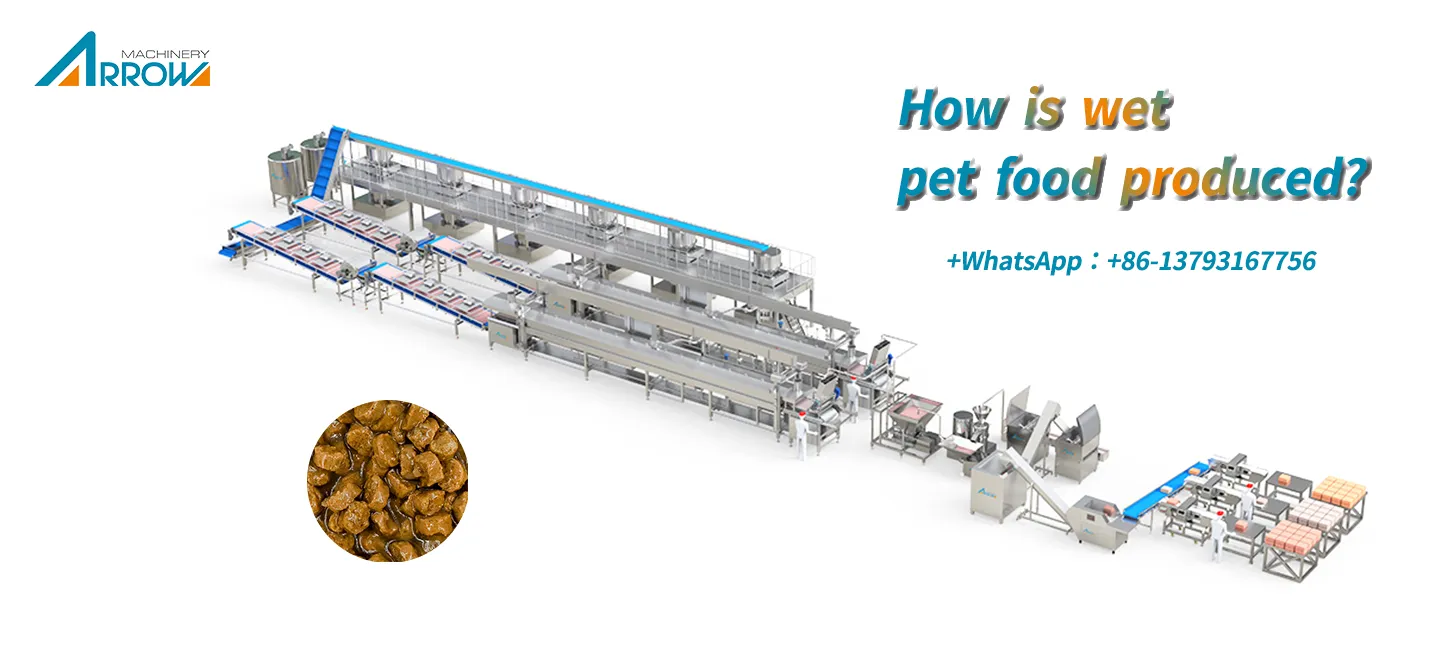 (1) Fresh Meat Processing: Fresh or frozen meat is processed by an industrial grinder and a high-speed emulsifier to produce a fine and uniform meat paste. This step is crucial because emulsification directly affects: product texture, digestibility, final appearance, and filling consistency. A uniform meat paste also improves the efficiency of subsequent processing.
(2) Pumping and Material Conveying: A food-grade screw pump gently conveys the prepared meat paste to the forming system. The pumping process is carefully designed to prevent: air bubbles, fat separation, raw material sedimentation, and product inconsistency. Continuous conveying also improves production stability.
(3) Material Forming System: Minced meat is extruded into customized strips, cylinders, or other shapes according to product requirements. Interchangeable molds allow manufacturers to quickly switch between different product specifications, enabling flexible production of multiple product categories.
(4) Steam Tunnel: The formed meat strips enter a continuous steam tunnel. The steam tunnel features: food-grade stainless steel conveyor belt, automatic steam control, uniform heating, adjustable temperature and humidity, and easy cleaning. The controlled heating process ensures full protein coagulation while retaining nutritional value.
(5) Primary Cooling: After heating, the product is rapidly cooled using a high-efficiency air cooling system. Rapid cooling helps: prevent overcooking, maintain product texture, reduce surface moisture, and improve cutting accuracy.
(6)Cutting System: The cooked meat strips are cut into uniform squares or blocks. The cutting length can be adjusted according to the specifications of canned food, bagged food, trays, or other packaging forms.
(7)Secondary Cooling: The meat chunks are further cooled to the optimal filling temperature. Proper cooling ensures: better appearance, stable product shape, purer gravy, and higher packaging efficiency.
(8) Gravy or Jelly Preparation: A separate broth unit is used to prepare gravy, jelly, or sauce. Automated ingredient metering improves product consistency while reducing labor costs. An optional broth extraction system maximizes nutritional value and creates a superior, flavorful formula.
(9) High-Temperature Sterilization: Commercial sterilization is one of the most critical processes in wet pet food production. Proper sterilization eliminates pathogenic microorganisms, extends shelf life, ensures food safety, maintains nutritional quality, and ensures compliance with international food regulations.
(10) Cooling, Inspection, and Final Packaging: After sterilization, the product undergoes a final inspection process. Qualified products are labeled, packaged, palletized, and prepared for shipment worldwide.
3.Why Choose an Automated Wet Pet Food Production Line?
Compared to traditional manual production, modern automated wet pet food production lines offer significant advantages:
(1) Higher production efficiency;
(2) Lower labor costs;
(3) Stable product quality;
(4) Precise formula control;
(5) Less product waste;
(6) Safer food;
(7) Easier equipment cleaning;
(8) Flexible product development;
(9) Compatibility with multiple packaging sizes;
(10) Stable continuous production.
Whether producing wet dog food, wet cat food, canned pet food, or wet pet pouches, automation helps manufacturers expand production scale while maintaining high-quality products.
4.Shandong Arrow provides complete turnkey solutions for wet pet food processing.
As a professional pet food processing equipment manufacturer, Shandong Arrow provides complete turnkey solutions for pet food manufacturers worldwide.
Our solutions include: factory layout design, installation and commissioning, operator training, technical support, and after-sales service.
Whether you are building a new factory or upgrading an existing production line, our engineering team can customize equipment based on your capacity, product type, factory layout, and investment budget. From formula development to complete factory solutions, Shandong Arrow helps clients build efficient, reliable, and internationally competitive wet pet food production bases.
Contact our engineering team today for customized equipment recommendations.
FAQ:
1. What are the advantages of wet pet food compared to dry pet food?
—Wet pet food typically contains 75% to 85% moisture, helping pets retain more moisture. It also has better palatability, a softer texture, and higher protein digestibility, making it especially suitable for puppies, kittens, senior pets, and animals with teeth or chewing difficulties.
2. Can one production line produce different types of wet pet food?
—Yes. Modern wet pet food production lines support multiple product formats, including canned food, cat treats, wet food pouches, and customized functional formulas, simply by changing molds, filling systems, and packaging equipment.
Technical Support: Yandex






 +86-531-83146566
 info@arrowextrusion.com