

A panko bread crumb production line is specified by the crumb, not by the machine. Two lines running the same nominal capacity can deliver crumbs that behave completely differently in a fryer, in a bag, and on a customer's plate. The reason is the route: fermented bread panko and extruded needle-flake panko reach a similar appearance through very different process physics, different building footprints, and different labour patterns. Shandong Arrow builds both routes as turnkey lines, so the useful question is not which machine is better, but which route matches your crumb spec, your building and your order book.
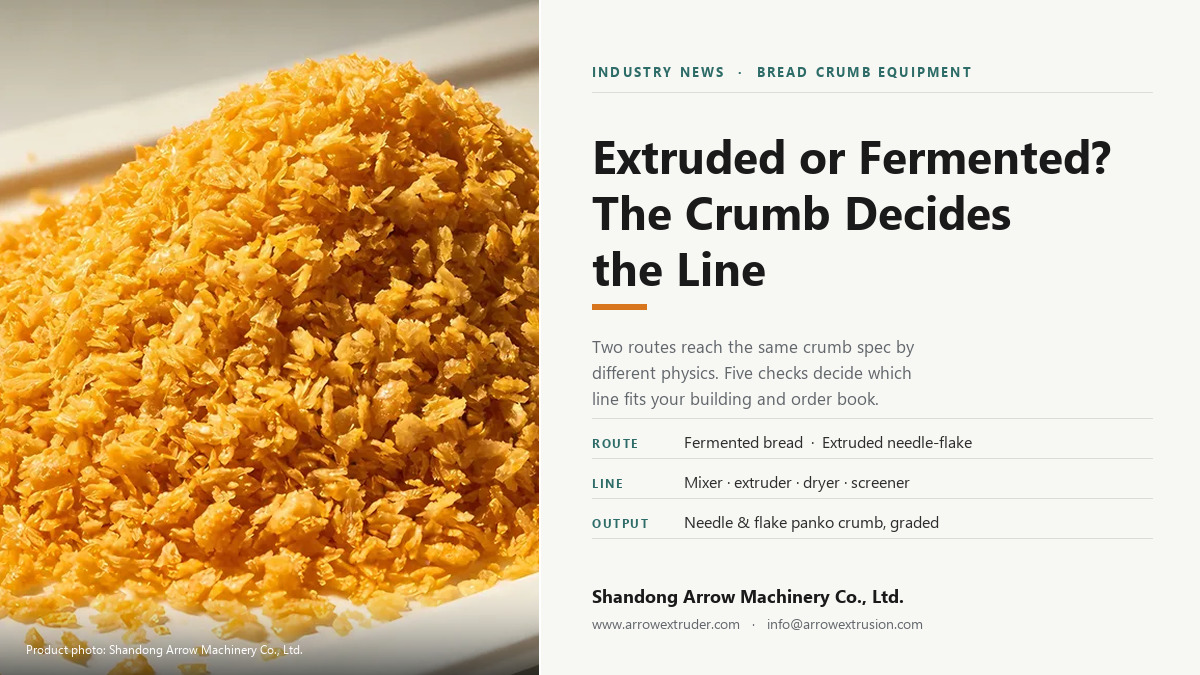
Before comparing equipment, agree on the four properties that decide whether a crumb sells. They are the same properties a QA team checks on arrival, and they should appear on the quotation as targets rather than as adjectives.
(1) Shape and length distribution. Japanese-style panko is judged on needle form: long, thin, angular slivers with a narrow length band. Short broken crumbs and dust read as cheap, and they also fall off the product during frying.
(2) Colour and crispness after frying. A good crumb browns to an even golden tone and stays crisp instead of turning greasy and soft within minutes. Crust colour traces back to the bread or extrudate structure that the crumb was cut from, so it is set long before the fryer.
(3) Oil pickup. Surface structure governs how much oil the coating absorbs. Open, irregular crumb surfaces take on more oil; a tight, uniform needle structure keeps the coating lighter and the bite cleaner.
(4) Bulk density and breakage in transit. Crumb is sold by weight but used by volume, and it travels poorly. Density and mechanical strength at the screening stage decide how much of the bag arrives as usable crumb rather than powder.
The fermented route starts from dough and ends with graded crumb, with a real bakery in the middle. It is the traditional Japanese route, and it is the only way to obtain genuine fermented aroma, which some retail and food-service specifications name outright.
Two things about this route drive the investment. First, the crumb's character is created by fermentation and ageing, not by the crusher — so the proofing and ageing stages need time, floor area and climate control, and the line cannot be compressed on demand. Second, cold-chain steps at low temperature make energy a continuous operating cost rather than a start-up cost. In exchange, the route delivers aroma, a light and irregular needle structure, and a premium claim that is easy to defend to buyers.
The extruded route replaces the bakery with a twin-screw extruder. Raw materials are mixed, cooked and expanded inside the barrel, cut at the die, then crushed, dried, screened and cooled. The published process runs seven stages.
The engineering value sits in the extruder. A modular screw set and a multi-section barrel let the operator adjust shear, temperature and pressure to shift crumb texture between batches without changing hardware, which is why the same line can produce needle-shaped and flake-shaped crumbs of different density and colour. The line runs continuously and automatically, so the cycle is measured in hours rather than days, and the footprint, headcount and building height required are all substantially smaller than a fermented bakery route. What it does not reproduce is fermentation aroma — that claim belongs to Route A only, and buyers should be told so honestly.
See the panko bread crumb production line page for both process flows, and the AYT series twin-screw extruder for the core machine.
Run these five checks in order. The first three usually settle the decision before cost is discussed.
| Check | Fermented bread route | Extruded needle-flake route |
|---|---|---|
| Building and footprint | Needs proofing, ageing and cold-room space; significant height and floor area | Compact continuous line; fits an existing hall more easily |
| Order pattern | Better for stable, large batches of one premium spec | Better for mixed orders and frequent size or colour changes |
| Labour and energy profile | Labour-intensive bakery stages plus continuous refrigeration | Automatic operation, energy concentrated at extrusion and drying |
| Crumb spec target | Aroma, irregular long needles, premium positioning | Uniform needle or flake shape, tight size band, repeatable density |
| Downstream capacity | Drying and screening must match a wet, dense crumb | Drying and screening must match a lighter, drier extrudate |
A frequent mistake is to size the crusher and then discover the dryer, not the crusher, sets the pace. Crumb leaves the crushing stage with high surface moisture and a wide particle spread; drying and screening decide final moisture, colour and the usable yield of the size band you promised. Both routes therefore need the drying and grading section designed together with the front end, not added afterwards.
After crushing, the material passes a vibrating fluid bed dryer, which dries and cools in one continuous pass and is gentle enough to limit further breakage of needle-shaped crumb. Screening then splits the stream into the size bands your customers buy, and oversize material is returned to the crusher rather than discarded.
Three settings at this stage decide how much of your output is sellable: air volume and bed depth in the dryer, screen aperture sequence, and crusher gap. Get them right and the same front-end equipment yields a noticeably higher proportion of prime crumb; get them wrong and the line looks like a capacity problem when it is really a grading problem.
Shandong Arrow supplies both routes as engineered lines rather than equipment lists: process layout, equipment sizing, PLC-based automatic control, installation guidance, commissioning and operator training. Because the same engineering team quotes the extruder, the dryer and the screening section, the interfaces between stages are fixed at design time instead of being negotiated on site.
To get a configuration and a costed scope rather than a brochure, send four inputs: target finished output in kg/h, the crumb spec you must match (needle or flake, size band, colour target, aroma requirement), available building height and floor area, and your typical order pattern. With those, the route choice and the bottleneck list can be answered before any quotation is written.
Tel: +86-13793167756 | Email: info@arrowextrusion.com | Contact our engineering team
Crispness after frying comes from a dry, structurally sound crumb with a tight needle shape, so both routes can deliver it when drying and grading are set correctly. The fermented route adds aroma and a more irregular, artisan-looking needle; the extruded route gives a more uniform shape and density from batch to batch. If the specification is written around aroma, choose fermentation; if it is written around consistency and changeover speed, choose extrusion.
Yes, within limits. A modular screw configuration and multi-section barrel allow the texture to be shifted by adjusting shear, temperature and pressure, and the die and cutting set the shape. Practical range depends on the size bands you need and the throughput you expect at each setting, which is why the size band list should be part of the line specification.
It follows from the route and the capacity. The fermented route needs proofing, ageing and low-temperature refrigeration rooms in addition to the processing line, so building height and floor area are usually the binding constraint. The extruded route is continuous and compact, and is often the only option when an existing hall must be reused. Send your available dimensions and we will confirm whether the route fits before quoting.
Technical Support: Yandex






 +86-531-83146566
 info@arrowextrusion.com