
Nameplate pet food extruder capacity rarely survives contact with a real recipe. The gap usually sits in three places: recipe moisture, barrel length-to-diameter ratio and the drying stage, each calculated alone instead of together. Shandong Arrow runs a five-step check before quoting a line.
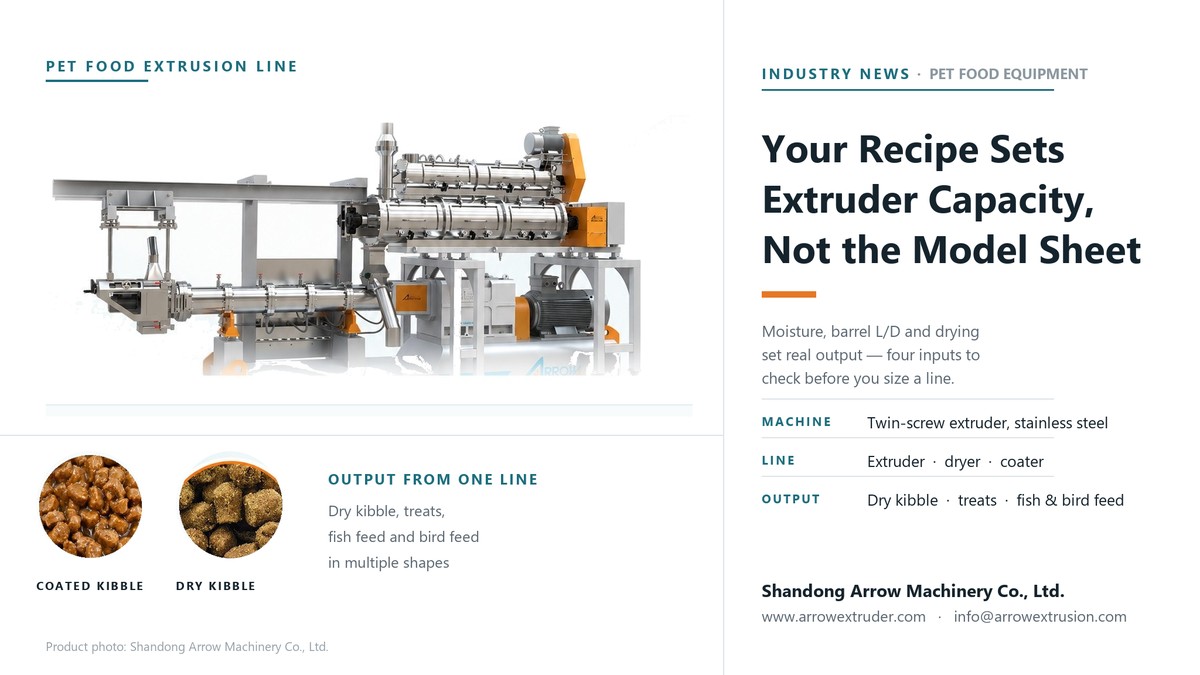
Pet food production line capacity calculation begins with water, not with a model number. Petfood Industry's January 2026 cost review ranks equipment, energy, ingredients and process first. Three streams share one budget: water in fresh meat slurry, steam from the preconditioner, water injected for expansion. Every extra point of moisture becomes dryer load, and the extruder is capped by whatever sits downstream. Barrel L/D and screw configuration come second: they set residence time and shear, which decide kibble density. Die open area and knife speed come third: too little open area and torque runs out before throughput does.
Extruder throughput and recipe moisture are often reduced to more water, better expansion. In practice it inverts. High moisture flashes harder at the die, gives uneven expansion, and pushes the whole evaporation load onto the dryer. Low moisture under-gelatinises starch, so density and durability drop, and the customer asks for more speed to compensate. Judge by bulk density drift, not the output table: sample two hours of one recipe and check moisture before touching the motor.
Send your recipe (fresh meat share, starch source), target output and building height. We return a line configuration and a bottleneck list within 48 hours.
How to choose a twin-screw extruder model: start from four known values instead of the catalogue. Finished output measured as product, the ratio of fresh meat to starch, kibble diameter with target bulk density, and available floor height with installed power. Those four fix the L/D range, drive class and die set; the model number is the result.
| Known value | What it fixes | What buyers usually leave out |
|---|---|---|
| Finished output (product basis) | Drive class and line pace | Feed rate only, no evaporation or trial loss |
| Fresh meat to starch ratio | Preconditioning, zone profile, screw set | Meat share without saying slurry or meal |
| Kibble diameter and bulk density | Die open area and knife speed | Shape only, no density target |
| Floor height and installed power | L/D ceiling and layout | Power unchecked, retrofit cost later |
Smaller dies cut throughput as physics, not as a fault. When a recipe still needs proving, a smaller AYT barrel runs the trial batch before scaling to a full pet food production line. Published AYT twin-screw extruder specifications run from AYT65 at 500-800 kg/h and 37 kW to AYT155 at 8,000-11,000 kg/h and 355 kW.
In a 1000 kg/h pet food production line, the extruder is seldom the limit. The dryer needs enough belt area and zoning, the coater needs even oil atomisation, and cooling and packing must hold the same pace. Our filled-kibble lines are quoted from 100 to 1,000 kg/h and built to order; extruded kibble output is calculated per recipe, not copied from another line. Changeover counts too: cleaning and reset between a high-meat and a low-fat recipe eat into daily capacity.
If a line is already running, send current output, kibble bulk density and kWh per tonne. We will trace whether recipe, die or downstream equipment is holding capacity back.
Shandong Arrow Intelligent Equipment Co., Ltd. | Tel: +86-13793167756
On a finished-product basis. Deduct evaporation and trial loss first, then find which stage reaches its ceiling first. The bottleneck stage, not the extruder nameplate, sets line capacity.
No. The model sets the power and barrel volume ceiling. Die open area, recipe moisture and drying capacity decide what you actually get, so a larger machine can still run short.
It follows from outlet moisture, final moisture and kibble diameter. Calculate evaporation first, then belt area and zoning. Dryer length is an output of the calculation, not an input.
Technical Support: Yandex






 +86-531-83146566
 info@arrowextrusion.com